Fuse beads and the pixel — from a 1962 patent to sprite art
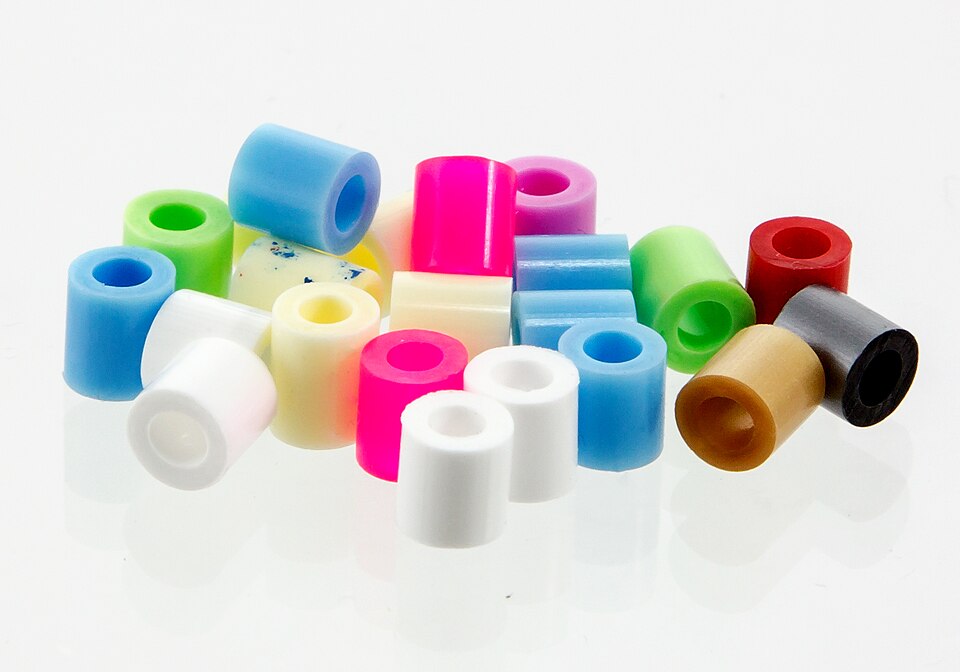
The fuse beads children iron onto pegboards were invented for therapy. The craft's documented start is a Swedish patent, applied for on April 24, 1962, for a method of making patterned plates for occupational therapy — the beads were a treatment tool for the elderly before they were ever a toy. The patent itself describes what every Perler or Hama crafter knows how to do now: small tubular beads, arranged on a pegboard, fixed into a permanent patterned sheet.
Patent to pegboards to brands
Sweden kept the first decade to itself. Hama began producing pegboard beads in 1971 (its fusible form arriving in the late 1970s), and in the early 1980s the idea crossed the Atlantic: Peter and Dee Dee Schneck founded the Perler brand in California in 1981, and the craft's American adoption rode the decade's boom. The brands became the search terms — "Perler beads" in the US, "Hama beads" across Europe — for what is one craft: multicolored tubular plastic beads, arranged on a 5 mm pegboard grid and fused under a clothes iron through parchment paper.
The grid finds its century
What pushed it from toy to art form was a shape coincidence. A pegboard is a square grid of discrete positions; a computer's 8-bit screen was the same thing. Through the 2000s, online communities filled fuse-bead boards with recreated pixel-art sprites from video games — the craft's grid and the pixel's grid are the same object — and the work scaled up: a fuse-bead picture measuring 4.65 by 8.70 metres, assembled from 1,680,200 beads, was made in Sweden's Väringaskolan schools in 2015. The medium that started as a therapy grid now runs from pocket sprites to wall-scale mosaics.
The grid, and everything this site does with it
Every counted craft on this family's shelves is a grid statement: peyote offsets its grid half a bead, loom sits its rows on strings, fuse beads lay theirs flat and melt them into one plate. The app's fuse-bead craft carries the same chart grammar as the rest — and the free charts here include the fuse-bead shapes to print for a class or a rainy afternoon. The line from a therapy patent to a pocket sprite runs through one invariant: count the cells, place the color, hold the pattern.
Print a chart, pixel something this week. — the bench crew

